Adjustable Rings: Why They Defined the 2003–2011 Era
Statement Form Without the Sizing Barrier
Between 2003 and 2011, one format quietly reshaped how people wore statement jewellery: the adjustable ring.
While bold crystal clusters and sculptural metalwork dominated design, it was the open-back adjustable band that made these pieces widely wearable.
The format removed friction. It allowed scale without intimidation.
And it became one of the defining characteristics of the era.
Designed for Presence
The early 2000s saw rings grow larger — higher profiles, wider settings, layered stones, dramatic colour contrasts.
Large bezel-set crystals and clustered faceted glass demanded structural support. Adjustable bands provided it.
Instead of delicate sizing, designers opted for:
- Open shank backs
- Flexible metal tension
- Wider structural bands
- Reinforced settings
This allowed rings to carry substantial weight without sacrificing comfort.
They were built to be seen.
Why Adjustable Worked So Well
Adjustable rings solved several practical issues:
- No need to stock multiple sizes
- Easier gifting
- Comfortable across seasonal finger changes
- Encouraged bolder design
For brands such as Pilgrim, A&C Norway and Konplott, this flexibility enabled scale. Designers could focus on sculptural form rather than precise sizing constraints.
The result was rings that felt architectural rather than delicate.
Metal & Structure
In this period, adjustable rings were rarely minimal.
You’ll often see:
- Oxidised finishes for depth
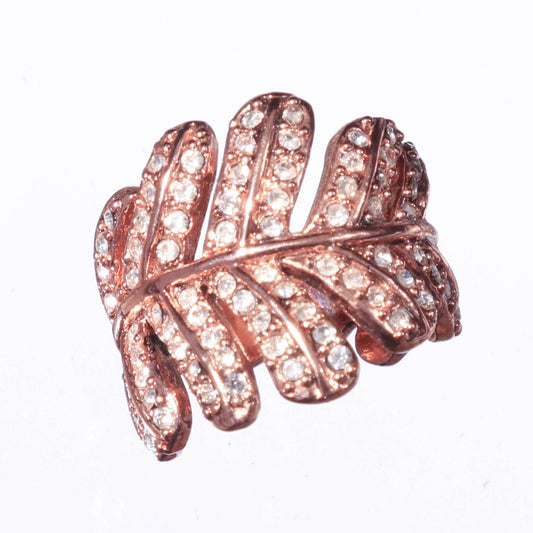
- Silver-tone, gold-tone or copper accents
- Large bezel-set stones
- Multi-stone clusters
- Height and layered construction
The open band is not an afterthought — it is part of the engineering.
It allows the top form to remain dominant.
Colour & Impact
Adjustable rings from 2003–2011 frequently embraced strong contrast.
Deep jewel tones against darkened metal. Clear faceted glass catching light from multiple angles. Warm copper against cool crystal.
Because the band allowed greater scale, designers leaned into visual impact.
These rings were not background pieces.
They framed the hand.
Recognising an Early 2000s Adjustable Ring
Look for:
- An open shank at the back
- Substantial metal weight
- Sculptural or raised settings
- Bezel-set or clustered stones
- Strong colour contrast
They often feel more solid than modern fast-fashion adjustables.
There is intention in the build.
Why They Still Work Today
Adjustable rings from this era remain practical and wearable.
They adapt easily across finger sizes. They stack well with slimmer bands. They act as focal points in otherwise minimal styling.
But more importantly, they represent a moment when jewellery embraced scale without hesitation.
They carry confidence.
Curated by Artyfax
At Artyfax, adjustable rings from 2003–2011 are selected for structural integrity, colour balance and sculptural presence.
They are not chosen because they are adjustable.
They are chosen because they hold form.
In the Crystal Sculptural and Studio Glass movements of the era, the adjustable ring became the format that made bold design accessible — without reducing its impact.